

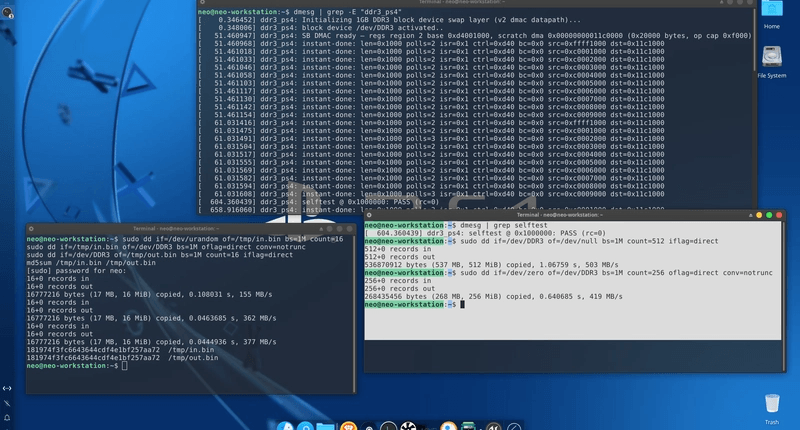
The KHEOPS team has been busy working on improving Linux for PS4. A young dev on the team, Debarshi recently worked on a PS4 Pro Belize Kernel patch that unlocks DDR3 read speeds of 504MB/s. Please note that, the read speeds before this patch was an abysmal 10.6MB/s. This patch also increases the write speeds from almost 138MB/s to 425MB/s.
Now, I know for most of us these just seem to be an advancement mainly for the developer community. But, that’s not the case. This patch will improve PS4 Linux experience for everyone!
Does the PS4 Pro DDR3 patch improve gaming on PS4 Linux?
Debarshi himself has confirmed that he noticed better loading times in games like Metal Gear Solid V on PS4 Linux. Moreover, he also states that it will improve caching performance in shader compilation. So, it’s a great advantage for you emulation fans as well, who can hope to see better performance when using Batocera for PS4.
To put it simply, while playing a few AAA titles on PS4 Linux, we compulsorily have had to enable swap to avoid crashes. But, since swap lives on the USB devices or hard drives, they are slow. The swap itself was necessitated because the internal PS4 RAM while on Linux was initially running at 10 times slower speeds before this patch. So, with this patch, reliance on slower swaps can be removed since the bottleneck is removed.
Distributions like Fedora can also make better use of zram hopefully with this patch. So, all in all, it’s a big win for the PS4 Linux community.
What was the PS4 Pro DDR3 bottleneck that caused slower speeds?
You can read Debarshi’s writeup for more details.
So, it was found that Orbis OS (PS4’s default game OS) has a likely proprietary RAM driver which has the capability of using the full speed DMA (Direct Memory Access) engine is capable of. Unfortunately, this driver is closed-source. Debarshi then used AI to reverse-engineer Orbis OS’ kernel binary with which he was able to find the offsets, including source and destination of the chip responsible for deciding the RAM speed.
Another interesting find after the reverse-engineering was that unlike traditional DMA engines (detected as a PCI device on PS4 Linux), the PS4 allocates a small chunk of RAM (< 4GB) that acts a buffer between the CPU (APU) and the RAM. The 14-year old developer was able to use this to his advantage and patch the PS4 Linux kernel to make use of this.
What is DMA?
Gemini’s overview:-
Direct Memory Access (DMA) is a computer architecture feature that allows peripheral hardware devices (such as graphics cards, network cards, and disk drives) to transfer data directly to and from main system memory (RAM) without continuously involving the Central Processing Unit (CPU).
Performance difference: Old kernels vs Debarshi’s kernel
Here is the table shared by the developer himself:-
| Old Kernels | Patched Kernel | |
|---|---|---|
| Read Speed | 10.6 MB/s | 504MB/s |
| Write Speed | ~138 MB/s | 425MB/s |
| Ceiling | Unknown | ~1.4GB/s |
Conclusion
Keep in mind that right now, the kernel hasn’t been made available for download, but, that will be soon hopefully. Also, right now, it’s aimed at Belize Pros, though, I am sure the team is working on bringing it to all the iterations.
Leave a Reply